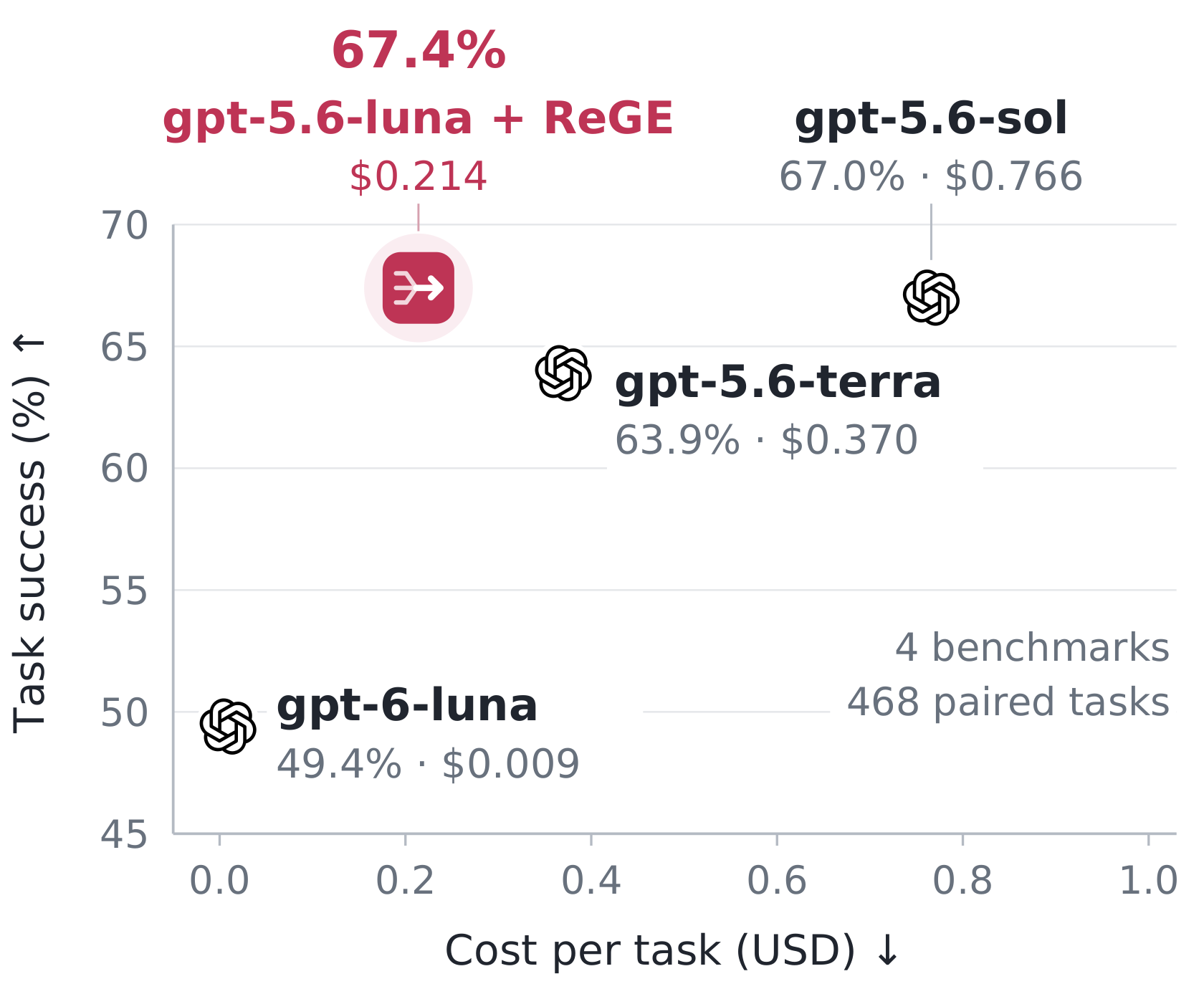
With ReGE, gpt-5.6-luna matches gpt-5.6-sol at 28% of its cost
Guided by its own recorded attempts, the lower-priced model reaches the task success of a higher-priced model of its family. Costs include generating the source pool.
67.4% vs 67.0%average task success of gpt-5.6-luna with ReGE and of gpt-5.6-sol
$0.214 vs $0.766list-price cost per task, including the four source attempts of ReGE
$0.034per task for ReGE when the source pool already exists, close to the $0.041 of one unguided gpt-5.6-luna run
Figure 1 of the paper: averages over 468 tasks of Terminal-Bench 2.0, Spider2-Lite, AndroidWorld and BrowseComp-Plus. Results per benchmark (Table 5) →
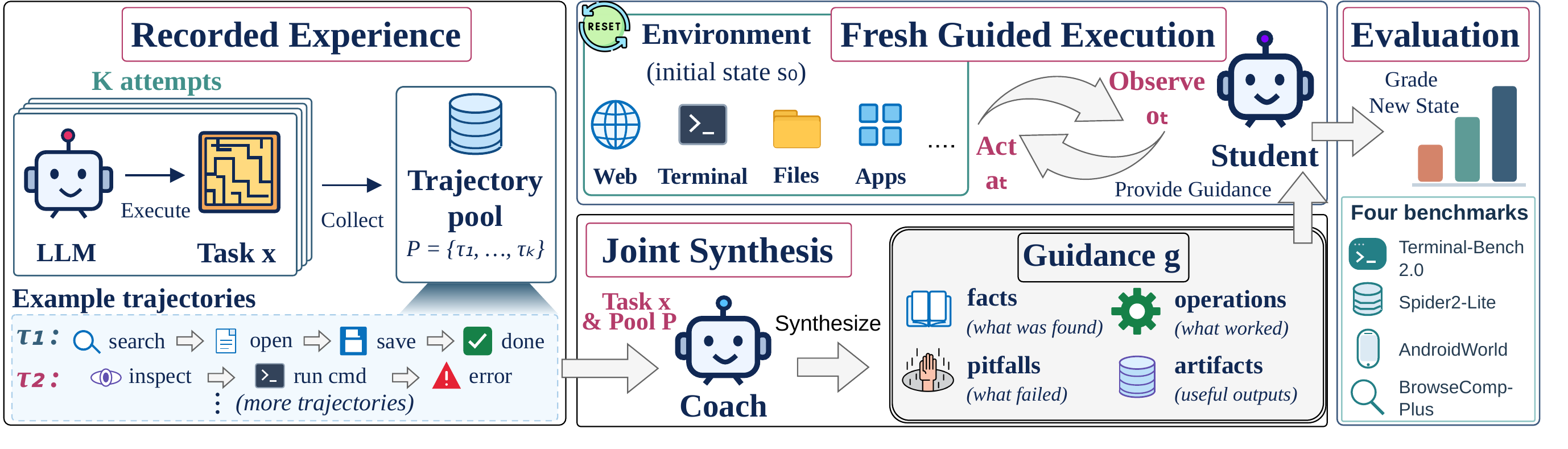
ReGE turns an agent's own recorded attempts into guidance for a fresh attempt. In its main implementation, one coach call synthesizes what the attempts found, what worked and what failed, and the same model then re-executes the task from its initial state.
+9.9 pp
mean gain in task success over unguided execution with gpt-5.6-luna across four benchmarks (+8.8 with claude-sonnet-5)
−98.2%
guidance-construction tokens versus adapted AggAgent on matched BrowseComp-Plus queries with GPT (−95.5% with Claude)
−35.4%
construction plus execution tokens versus AggAgent with Claude (−15.7% with GPT), excluding source generation
1 call
of the ReGE-Syn coach turns four recorded attempts into self-contained guidance, with the same base model and no parameter updates
Abstract
How can an agent turn its own attempts into better execution?
Repeated attempts at interactive tasks uncover facts, useful operations, and failures that can inform subsequent execution. We introduce ReGE, a framework for turning this recorded experience into guidance for a fresh attempt. Its main implementation, ReGE-Syn, uses a single coach call to jointly synthesize bounded execution records and available artifacts into self-contained guidance, connecting task-specific findings with proposed actions and relevant pitfalls. A student starts from the task's initial environment state and adapts this guidance to current observations. Source generation, synthesis, and student execution use the same base model, without parameter updates or a stronger teacher. Across four benchmarks, ReGE improves accuracy by an average of 9.9 percentage points for GPT and 8.8 percentage points for Claude compared with unguided execution. On matched BrowseComp-Plus subsets, ReGE-Syn reduces guidance-construction tokens by 98.2% on GPT and 95.5% on Claude relative to adapted AggAgent, with observed success. Combined construction and execution tokens decrease by 15.7% and 35.4%, respectively, counting input plus output and excluding source generation. BrowseComp-Plus ablations further associate access to process information with fewer student steps and show that joint synthesis produces substantially shorter guidance than Direct history or Independent summaries, with observed success. These results demonstrate how agents can use their own recorded experience to improve subsequent task completion, and suggest a low-cost way to consolidate the execution records of parallel agent systems such as agent swarms.
01Method
Record, synthesize, re-execute
ReGE (Re-execution Guided by Experience) needs only the agent's recorded attempts at a task. The guidance is built without correctness labels, and the student re-executes the task in a fresh environment with the same base model.
1Record
Attempts form a source pool
The model attempts the task four times. Each attempt is rendered as text without any LLM summary: reasoning or action narratives and commands in step order, then the final artifacts, such as files, SQL results or a submitted answer. Correctness labels and raw observations are left out, and long fields are truncated.
2Synthesize
One coach call writes the guidance
A coach reads all attempts together and writes a plan in execution order, placing the exact paths, values, commands and formats the attempts uncovered at the steps where they matter, along with the pitfalls they exposed. When the records support a candidate answer or artifact, the plan states it with a way to verify it.
3Re-execute
A fresh student acts on it
The student starts from the task's initial state with the instruction and the guidance. Files and state from the earlier attempts do not carry over, so it adopts, adjusts or skips each proposed operation against what it observes, and the benchmark grades the result.
The joint-synthesis implementation of ReGE.
The coach reads the rendered source pool, the recorded attempts at the task, and writes guidance in one call.
The student receives the guidance and interacts with its own environment from the task's initial state.
Source generation, synthesis and execution share the same base model.
How ReGE-Syn differs from other aggregation methods
Table 1 of the paper.
Criterion
SC (source)
Self-MoA
Reflexion
Agentic PDR
AggAgent
ReGE-Syn
Single-pass synthesis
×
✓
×
×
×
✓
Trajectory information
×
×
✓
✓
✓
✓
Student rerun
×
×
✓
✓
×
✓
Aggregation calls
0
1
Iterative
K
Iterative
1
Aggregation calls count model calls that combine source attempts (reflection calls for Reflexion), excluding source generation and task execution; K is the number of source attempts.
02Results
Recorded experience strengthens the same model
We evaluate on Terminal-Bench 2.0, Spider2-Lite, AndroidWorld and BrowseComp-Plus with gpt-5.6-luna and claude-sonnet-5. Each task has four source attempts by the same model; ReGE and AggAgent use the same pools, and each gets one fresh student execution under the benchmark's step limit.
Task success
ReGEBaselineControl (unguided)
Terminal-Bench 2.0 · 89 tasks
Spider2-Lite · 135 instances
AndroidWorld · 342 instances
BrowseComp-Plus · 830 questions
Self-Consistency votes over the source outputs and is reported only where the paper has it. Best-of-N reports the original grade of the judge-selected source, and Reflexion allows up to three executions. Hover or focus a row for its cost and its difference from Control.
Full results
Table 2 of the paper. Bold and underline mark the best and second-best task success on each benchmark.
Method
Terminal-Bench 2.0
Spider2-Lite
AndroidWorld
BrowseComp-Plus
Average
Task success · share of tasks the benchmark grades as solved (%), the large number in each cell.
Cost · source-generation tokens plus measured construction and execution tokens, relative to Control (×).
SC, Best-of-N · references that read the source pool without a new execution.
— · unavailable or inapplicable.
A lower-priced model matches higher-priced ones
Table 5 of the paper. Bold and underline mark the best and second-best value in each row of a block.
gpt-5.6-luna with ReGE against one unguided execution of other GPT models, on 468 tasks: the first half of Terminal-Bench 2.0, Spider2-Lite and AndroidWorld by task ID and the 300 BrowseComp-Plus queries of the ablations.
Task success (%)
Cost per task (USD)
Benchmark tasks
gpt-5.6- luna
gpt-5.6-luna + ReGE
gpt-5.6- terra
gpt-5.6- sol
gpt-6- luna
ReGE incl. pool
ReGE existing pool
gpt-5.6- terra
gpt-5.6- sol
gpt-6- luna
Terminal-Bench 2.0 44
40.9
63.6
59.1
68.2
34.1
0.187
0.028
0.251
0.601
0.005
Spider2-Lite 68
66.2
77.9
66.2
63.2
66.2
0.043
0.007
0.044
0.090
0.001
AndroidWorld 56
50.0
48.2
55.4
57.1
44.6
0.313
0.062
0.568
1.138
0.025
BrowseComp-Plus 300
70.0
80.0
75.0
79.3
52.7
0.314
0.038
0.615
1.237
0.004
Average
56.8
67.4
63.9
67.0
49.4
0.214
0.034
0.370
0.766
0.009
Other models · one execution per task without guidance, with the prompts, tools, step limits and graders of the gpt-5.6-luna Control runs.
Cost per task · list price of the input and output tokens, in USD per million: 0.20 / 1.20 for gpt-5.6-luna, 2.00 / 12.00 for terra, 4.00 / 20.00 for sol and 0.10 / 0.50 for gpt-6-luna.
Incl. / existing pool · the cost of ReGE with the four source attempts per task, and when the source pool already exists.
Guidance that is cheap to construct
Mean tokens per query on matched BrowseComp-Plus queries (Table 3 of the paper).
Guidance constructionStudent execution
gpt-5.6-luna
claude-sonnet-5
Input plus output tokens, including failures and excluding source generation. ReGE-Syn students use more tokens than AggAgent's, but construction drops by 98.2% (GPT) and 95.5% (Claude), so the totals fall by 15.7% and 35.4%; task success is 75.2% vs 75.3% (GPT) and 86.2% vs 87.0% (Claude).
03Findings
What makes recorded experience useful
Ablations on BrowseComp-Plus with claude-sonnet-5, and a breakdown of all benchmarks by how many source attempts succeeded.
The experience, not the coach
75.7% → 88.3% no attempts vs four
A coach that sees no source attempts (Closed-book) solves 75.7% of 300 queries, close to Control's 74.7%. One recorded attempt lifts success to 84.3%, two to 86.3% and four to 88.3%.
Process records, not just answers
14.6 → 9.1 mean student steps
Synthesizing from final submitted answers only (FAO) solves 85.0% instead of 88.3%. On queries with a single submitted source answer (6.3% of queries), full records solve 94.7% and FAO 47.4%; even when all four sources submit answers, mean student steps fall from 8.9 to 4.8.
Mixed pools gain the most
+13.0 to +48.0 points over Control
When some but not all source attempts succeed, ReGE-Syn gains 13.0–21.6 points on Terminal-Bench 2.0, Spider2-Lite and AndroidWorld, and 48.0 (GPT) and 35.2 (Claude) on BrowseComp-Plus. When every attempt fails, gains are small and inconsistent.
Joint synthesis keeps guidance short
5,063 characters vs 20,571
On matched queries, the joint guide is about a quarter as long as Direct history or Independent summaries, solves 88.3% against 88.3% and 86.9%, and uses 19.8% and 31.8% fewer total tokens. Other forms also work: ReGE-A (explanation and answer) reaches 90.7% at 0.68× the total tokens, though with gpt-5.6-luna on 100 queries it solves 80% versus 82%, and ReGE-Sel reaches 89.3% with 21% fewer student tokens.
04Cases
From recorded experience to a fresh execution
Two claude-sonnet-5 runs from the paper. The student checks the guidance against its own environment and changes course where needed.
Terminal-Bench 2.0db-wal-recovery
Recovering a database from its log
Recorded experience
Successful attempts identify the XOR decoding key 0x42 for the database's write-ahead log. Another attempt opens main.db before making a backup and loses main.db-wal, leaving the recovery incomplete.
Synthesized guidance
The guide keeps the decoding key and tells the student to back up both files before opening the database, decode and check the log, and then recover the records.
Student verification and adjustment
The student backs up its files, verifies the key and the decoded log, and moves the main.db-shm cleanup, which the guide offered only as a fallback, ahead of replacing the log and opening the database. It exports 11 ordered records to recovered.json and passes all seven official tests.
AndroidWorldBrowserMultiply
Completing a browser task from unsuccessful attempts
Recorded experience
Repeated taps on task.html leave the file manager unchanged. Two attempts discover the route long-press → More options → Open with → Chrome, but all four exhaust their 22-step budgets before completing the task.
Synthesized guidance
The guide keeps this opening sequence, warns against repeated single taps and describes Chrome's setup prompts. It asks the student to read the five numbers from the page and submit their product.
Student verification and adjustment
The student uses the opening sequence immediately. When dismissing Chrome's sync prompt returns it to the file manager, it repeats Open with → Chrome, records 9, 10, 9, 5 and 5 during the five clicks and enters 20,250. The page shows "Success!" after 19 steps, within the same 22-step budget.
05Citation
BibTeX
If you find ReGE useful, please cite our paper.
@article{rege2026,
  title   = {ReGE: Stronger Agents through Experience Synthesis},
  author  = {Liang, Jiarong and Wang, Yubo and Liu, Zijie and Zhang, Yuxuan and Nie, Ping and Chen, Wenhu},
  journal = {arXiv preprint arXiv:2610.33861},
  year    = {2026}
}